Impact of Gen AI
Good Pedagogy (and AI): A Visual Arts Case Study
Before the Artwork: Why the Creative Process Matters in the Age of AI
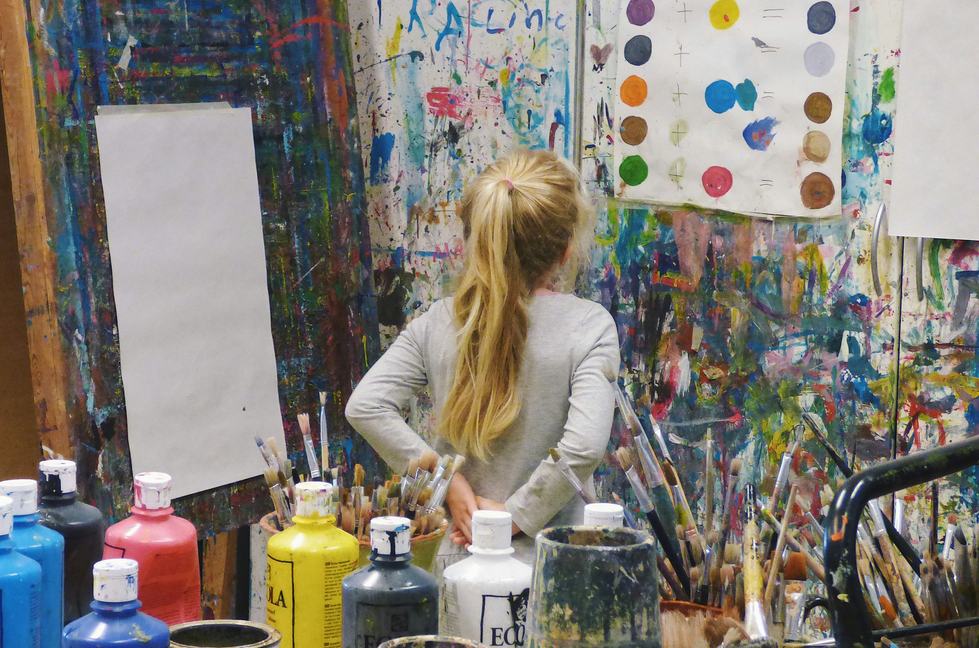
Walk into any Year 8 Visual Arts classroom and you will find half-filled art diaries, conversations with the teacher, continuous experimentation, new materials being tested and ideas that have changed direction three times.
This ideation process is key to the cognitive development of young teenage minds. At this age, young minds need opportunities to explore, stretch and tolerate new opportunities and ambiguity. This increases their capacity for developing thoughts that are abstract, reflective and intentional. Often, this process is best developed through externalising thinking through physical materials.
For some teenagers, they think this process can be replaced by artificial intelligence, however in an age of artificial intelligence it is exactly this process that is invaluable for students to undertake themselves.
The creative process, like the brain development of adolescents, is not linear. It is uneven, circular, insightful and relies on the combination of visual and verbal divergent thinking.
In Art, we encourage the fullness of this process by developing ideas from scratch, using the art diary as part “map-making” and part “planner” as we value the thinking that happens before the making.
This year, our year 8s began a 10-week unit based on the concepts of “Identity and Place”, involving the production of lino cuts, sketches, paintings, and ceramic figures. It involves photographs of their environment, records, memories, mind maps, sketches, collected objects, research on inspirational artists, experiments with materials and possible compositions for their lino design.
The ideas students generate are sometimes predictable, sometimes a little strange, some are immediately clear, others need to be sketched or verbally communicated. A conversation with the teacher or even another student can often create an unexpected association with another idea. Eventually, a project or concept begins to emerge over which students have a full sense of ownership.
What can appear externally as mess is actually an important learning sequence: encounter– imagine – generate – experiment – fail – evaluate – connect – reconsider – refine – make. In a nutshell, we call this “creative cognition”.
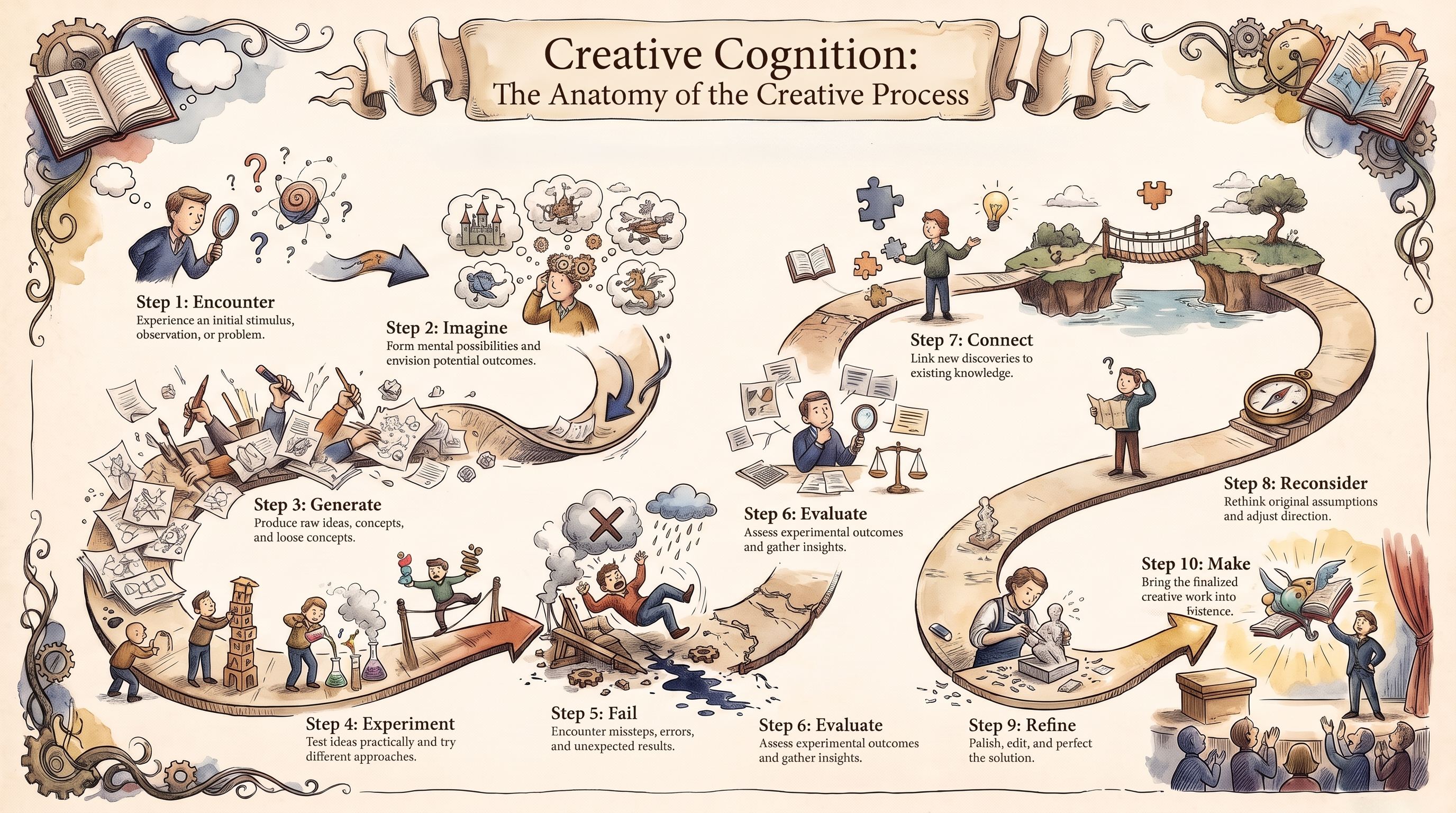
Source: Image generated using Notebook LM and author’s own visual stimulus. S. Evans, 2026.
Creativity research had previously suggested that creative cognition depended on interactions within the brain, often simplistically named the “right brain” network. However, as explained by Anna Abraham in her research “The Science of Creativity” (2018), this is an incomplete definition. Creative thought requires spontaneity and adaptivity, along with pathways for potential expansion of ideas and connections to personal experience. The movement through this pathway deeply matters.
The year 8 adolescent brain needs the journey.
It is important that AI is not introduced at the ideation phase, leaving a critical development stage untouched. However, as the purpose of AI is to spot patterns, plan and predict, it can help year 8 learners investigate and expose inspirational artists such as Whiteley or Nolan who dive into questions of identity, compare possibilities between artistic practice, organise information in their diaries, generate further open-ended questions about their own or other artists’ practice and test different possibilities using their chosen medium.
While it would be ultimately unhelpful for a student to prompt “what do I do here?” it has been beneficial to ask questions like “help me find an artist who is thinking of work like me to use as inspiration” or “what are the pros and cons of using watercolour versus acrylic for this work? Give me some suggestions of experiments with watercolour pencils versus paints that I might try” or “are there some tutorials I can watch that show me how to blend watercolour using a wet-in-wet technique?”
In our classes, we want thinking and doing, not blind following or copying. We want to see an engagement with tough questions and discussion around the concepts “identity” and “place”, as part of this unit.
Therefore, in our art classes, authorship and authenticity are a standard part of our practice. Students are explicitly taught the advantages of ideation and brainstorming; of being comfortable within that discomfort.
Only then do we extend our practice towards AI, such as asking the question “what artists have approached identity differently from the way I have?” Then, the addition of AI is one of an expansion of the thought process, not narrowing it. Ultimately, this is one of the key purposes of creativity in our year 8 classroom, which is about developing a person who can encounter uncertainty and think, “what might this become?”
Curiosity, divergent thinking, material and physical experimentation, persistence and reflection establish thought patterns that are skills for life and are foundational for creative and critical thinking capabilities.
The unfinished sketch, the failed experiment and the reformation of ideas therefore have new significance in the age of AI. They are not simply steps in an artwork.
They are evidence of a brain learning to create.
References
Abraham, A. (2018). The Neuroscience of Creativity. Cambridge University Press.

Sarah Evans
Sarah Evans is a Visual Arts educator, researcher, HSC Marker and Head of Visual Arts who is passionate about creativity and the changing nature of learning. She holds a Master's Degree in Educational Leadership (First in Leading Learning) and her thesis, The Impact of AI on Creativity in Education, reflects her ongoing interest in how artificial intelligence can be used thoughtfully within creative education. Drawing on her interest in the intersection of neuroscience, creativity and learning, Sarah explores how educators can embrace emerging technologies while protecting the curiosity, experimentation and human thinking that sit at the heart of creative exploration.

Impact of Gen AI
What are humans becoming with AI? Crowned Creatures or Sovereign Slaves?
Impact of Gen AI
What Story is AI Telling Us? Reading and Responding to the Gospel of Tech

Monthly Update
Monthly Update: Launching AI, Learning and the Developing Person

Parent Institute
The new Parent Institute: Supporting and sustaining confident parents


